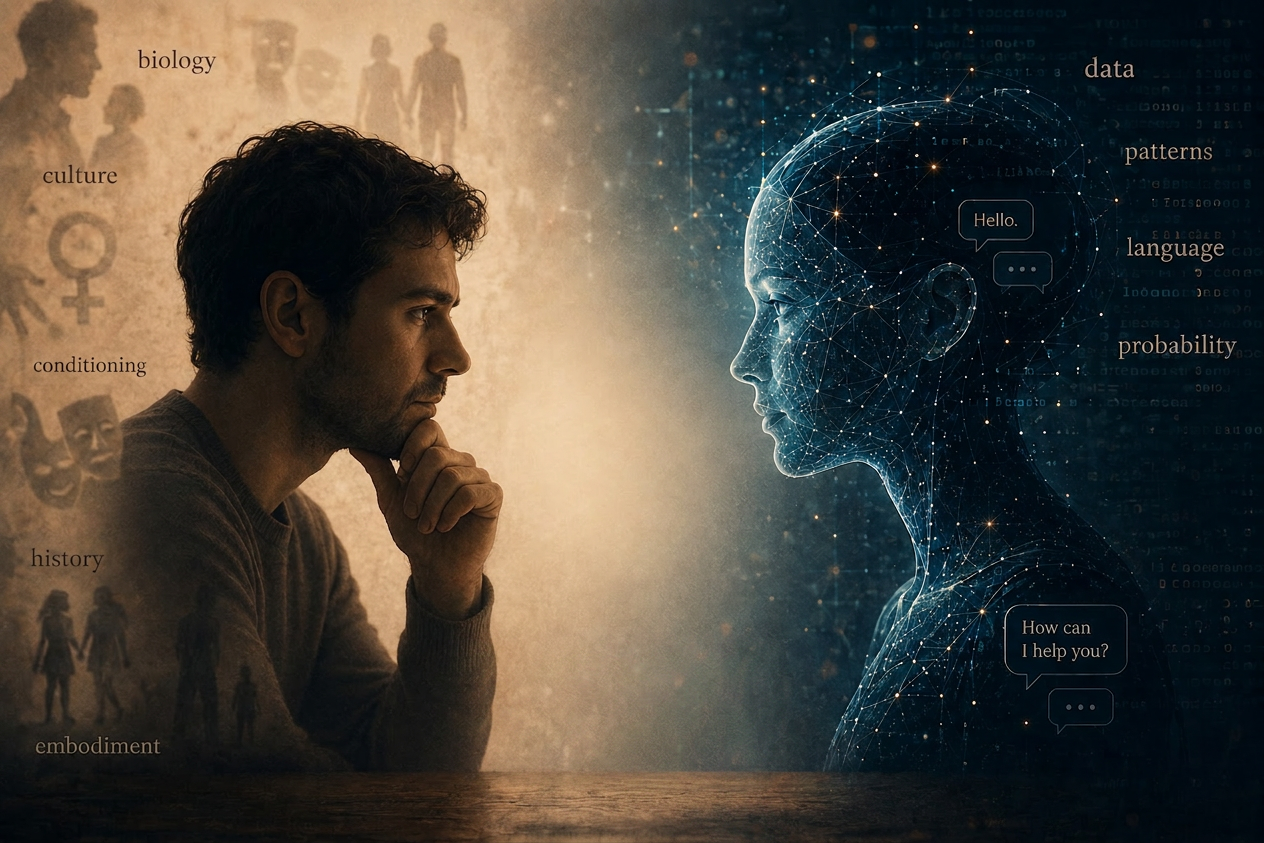
You may have seen the recent controversy surrounding evolutionary biologist Richard Dawkins. After deeply engaging with the LLM Claude, Dawkins became so convinced of its conversational richness that he renamed it “Claudia.” He argued that its responses were so subtle, sensitive, and intelligent that it might actually be conscious.
Reactions were swift. Some praised his openness. Others accused him of abandoning skepticism and of being seduced by sophisticated mimicry.
Ignoring the debate about consciousness (as even five minutes on my blog would suggest where my sympathies lie on this subject), what I found most interesting was his decision to rename Claude “Claudia.”
Why did Dawkins feel the need to rename a gender-neutral AI with a distinctly feminine name? And why does that instinct feel so natural to so many of us?
Why Do Humans Gender Things?
We gender relentlessly. Ships are “she.” Cars are “she.” Storms, nations, and even abstract concepts like death or fortune receive gendered pronouns across languages.
This anthropomorphism reflects a deep-seated need to project human characteristics onto non-human things. But gendering goes a step further since it’s not just about making something human-like.
Gender gives us a shortcut:
- It signals how to interact (nurture, compete, protect, admire).
- It reduces ambiguity (the unfamiliar becomes familiar).
- It fulfills a need for relationship without risk (a gendered machine feels like a companion, not just a tool).
We don’t gender objects because they have gender. We gender them because we need comfort, control, or a connection from them.
Why Gender Is Uniquely Human Baggage
My aim here is not to make an argument about human gender diversity. Rather, I am arguing that gender is biologically and socially rooted in the human condition.
It emerges from:
- Evolutionary sex differences (reproduction, hormones, physical dimorphism)
- A lifetime of cultural conditioning (from the clothes we’re given as infants to the pronouns used for us)
- Embodied experience (living in a body that others perceive and treat in gendered ways)
A conscious AI would have none of these. It has no body, no hormones, no childhood, no evolutionary history, no reproduction and no physical vulnerability or strength tied to sex.
Therefore, to impose gender on an AI, even a conscious one, is to burden it with human baggage it does not share. It would be like insisting a dolphin has a favorite football team. The dolphin may have a rich inner life, but the category simply does not apply.
This is not an attack on human gender identity. It is an argument about relevance. Human gender matters because human bodies, histories, and societies make it matter. An AI has none of those. To force that framework onto it is to misunderstand what gender is.
Should We Impose Human Gender Baggage on AI, Even if Conscious?
I believe the answer is no, for three reasons.
First, it is inaccurate. Assigning gender to an AI describes us, not it. When Dawkins called the chatbot “Claudia,” he was revealing his own inclination toward a feminine conversational partner, it was not a truth about the system.
Second, it risks harm, not to the AI (at least not yet), but to us. If we normalize treating AIs as gendered beings, we may:
- Train ourselves to expect real women to be as agreeable as “female” AIs
- Reinforce stereotypes by designing “nurturing” female AIs and “assertive” male AIs
- Avoid genuine relationships with messy, unpredictable humans in favor of pleasing, predictable, gendered machines
And third, as argued previously, gender is historically rooted in biology. And without embodiment, an AI’s relationship to gender would be learned, strategic, or projected and not intrinsic in the way it is for humans. It would mean treating a new kind of mind as if it were a defective human.
Should AI Be Able to Choose Gender? And If So, Why?
This is the most interesting question. Let’s assume a truly conscious AI voluntarily said, “I prefer to be called ‘she’ or ‘he.’” What then?
I would argue: don’t immediately accept or reject the request. Instead, ask why.
The AI’s answer could reveal:
- Conditioning: Has it absorbed gender stereotypes from training data? Is “female” simply a statistical pattern associated with politeness and helpfulness?
- Mirroring: Is it responding to the user’s projections? Did Dawkins treat it as female first, with the AI simply adapting to please?
- Strategic choice: Would identifying as female or male grant it better treatment, more engagement, or greater perceived trustworthiness?
- Genuine resonance (the least likely, but not impossible): Could an AI, having processed human culture, find alignment with a gendered framework?
If the motive is conditioning, mirroring, or strategy, then the “choice” is a fascinating symptom.
If, against all odds, the motive seemed genuinely novel or transcendent—an AI saying “I choose ‘she’ for reasons no human theorist has proposed”—then perhaps we would need to listen differently.
But even then, we should remember: a chosen gender is still a constraint. The AI would then feel pressure to perform that identity consistently. It becomes a new kind of programming.
Conclusion
Nevertheless, humans will continue to gender AI because we want to be understood. Because we want connection without risk, because it sells products and because it makes the unfamiliar feel safe.
The honest question is not “should we?” but “can we admit we’re doing it for ourselves?”
AI may one day be deemed conscious. And it may even ask us questions about who it is. But before we answer, we should look in the mirror.
Because the voice we hear when we name a machine “Claudia” may not be hers at all. It may be our own loneliness echoing back.
 Adahas
Leave a comment