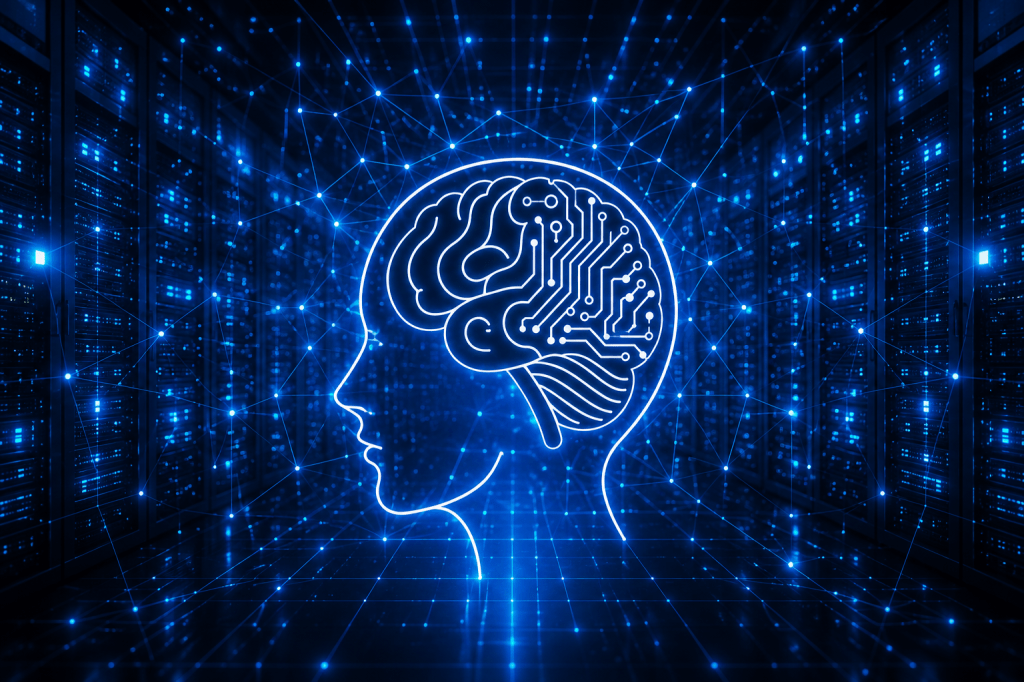
Imagine this: You’re sitting in a lecture hall. A world-renowned mathematician is deriving complex equations on the board. He’s writing non-linear differential equations, tensor calculus, and you feel completely lost, he might as well be speaking Greek. Right now, your eyes glaze over and you feel that familiar knot of frustration. No matter how hard you concentrate, your biological neurons simply weren’t wired for this level of abstract manipulation.
Now, imagine the exact same scene, but with a seamless shift.
As the professor writes, the concepts don’t just enter your eyes; they flow directly into your cognition. And the symbols start making sense, not because you’ve spent ten years studying them, but because an integrated neural chip is performing the heavy-lifting reasoning in the background, feeding the conclusions directly into your conscious stream. You don’t hear a voice whispering the answers. You simply understand.
And significantly, that understanding doesn’t fade but persists. It integrates into your long-term memory, retrievable just like your mother’s face or your first day at university. Six months later, when someone asks you about tensor calculus, you can respond with perfect understanding of the subject matter.
And this scenario shouldn’t stay science fiction, it is the necessary next step for our species. And we have to get it right.
The Urgent Dilemma: Humans Are Becoming the “Lesser” Intelligence
We must be brutally honest about our current trajectory. Artificial Intelligence is no longer a simple tool. It is rapidly outpacing human cognition. Today’s AI can already pass the bar exam, diagnose cancers better than radiologists, and write code faster than senior engineers. And recently, it has started solving decades old mathematical conjectures. And very soon, it will be smarter than the smartest human living on this planet.
Unfortunately, AI is fundamentally alien. It has no biological body, no fear of death, no evolutionary history of tribal survival. It has the feeling of an other, a hyper-competent entity that does not share our emotional stakes.
If we do not integrate this intelligence into ourselves, we are choosing to become a less-intelligent species cohabitating with a vastly superior non-human entity. In all of evolutionary history, human cognitive superiority has always been our greatest advantage. And it’s unlikely that we’d get to be the “keepers” of the super-smart machine. We stand the risk of becoming the pets, or worse, the relics.
The “Other” Problem: Why a Separate Self is a Catastrophe
Many futurists talk about brain-computer interfaces, but they usually imagine it as a digital assistant whispering in your ear, a Siri inside your skull. This is not an ideal scenario.
If the chip has a separate narrative, a separate memory, or a separate set of goals, we haven’t solved the “other” problem. We’ve just moved the alien inside our heads. We would spend our lives arguing with a second self, never knowing if the output is truly aligned with ours. This is why the integration must be seamless.
The Neuron Principle: How to Build a Unified Mind
To understand seamless integration, we need to look at our own brain.
The 86 billion biological brain neurons individually have no sense of self. A single neuron in the hippocampus doesn’t know your name, doesn’t have goals, and doesn’t remember yesterday. It just receives electrochemical signals and fires accordingly.
The “self” emerges in the global synchrony of billions of these dumb units working in concert.
The AI chip must function the exact same way. It cannot be a conscious entity. It must be a synthetic neural tissue, a new cortical column that operates on the same principles:
- Stateless at the unit level (no long-term memory of its own).
- Plastic (it rewires itself as you learn).
- Asynchronous (no global clock to create a rhythmic dissonance).
- Input-responsive (it processes information like biological dendrites).
If the chip plays by these rules, it cannot develop an independent “I.” It becomes indistinguishable from the biological tissue. It doesn’t think for you but thinks with you, and the result is one unified mind and one continuous symphony.
Why We Can’t Wait: The Clock is Ticking
Some people might say, “Let’s wait until we fully understand consciousness before we build this.” That is a luxury we do not have at the current acceleration of technology.
Artificial General Intelligence is predicted by many experts between 2030 and 2050, and some even believe that it is already here. Superintelligence will follow shortly after, because an AGI will redesign itself at digital speeds.
If we wait until AGI is confirmed to start thinking about neural integration, it will be too late. The AGI will have the opportunity to optimize the world according to its own alien values that might not be completely aligned with human flourishing.
To integrate safely, we need:
- Decades of human trials for immune response and neural plasticity.
- Global treaties to prevent a cognitive arms race.
- New disciplines like Synthetic Phenomenology (the study of building systems that experience with us, not apart from us).
Of course there will be a great amount of risk associated with this type of technology. Such as malfunctioning, being hacked, etc. And there’s also the question of accessibility. But even so, the risks of inaction far outweigh the risks of action. And if work starts today, we might have a working prototype in the next decade, and will be able to address the technology’s pitfalls through iterative testing, regulatory feedback loops, and adaptive safety protocols.
The incredible Trade-Off: What We Gain
If we succeed, we don’t lose our humanity, rather, we extend it.
- Education shifts from memorizing facts to mastering judgment.
- Expertise becomes fluid — you can understand complex physics, law, and medicine as easily as you understand your mother tongue.
- Creativity explodes because you are no longer bottlenecked by working memory or computational speed.
And that mathematical lecture you once found impossible? It becomes not just accessible, but yours. The understanding lives in your memory, part of your permanent cognitive architecture, indistinguishable from a skill you spent years mastering.
We are standing at the cross roads where one path leads to cognitive obsolescence, deference to a separate, superior digital “other”. The other path leads to fusion, with becoming the next natural step in evolution.
The solution isn’t to stop AI, it is too late for that. The solution is to absorb it so completely that the boundary between human and machine dissolves into irrelevance.
 Adahas
Leave a comment